2025 Annual Letter
December 1, 2025
Greetings friends and family and all our faithful supporters of FAR,
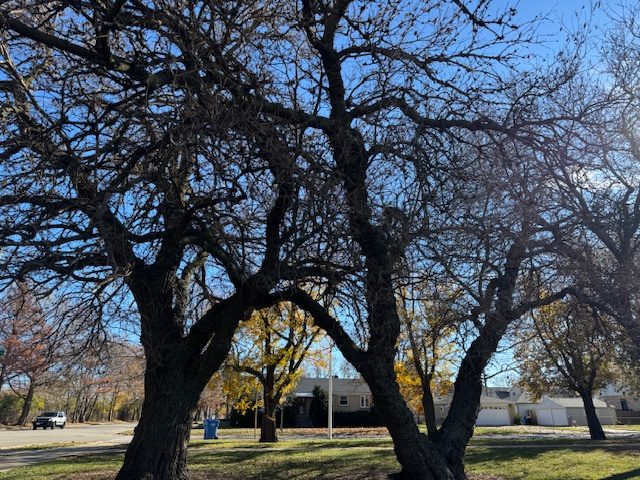
We had to have our lovely old Weeping Willow tree removed this past summer. Anyone familiar with Weeping Willow trees knows that they have a propensity to grow very large. Weeping Willows are a brittle tree, and when they grow very large, they tend to begin losing limbs. I didn’t know this at the time, but apparently in many municipalities, one is not allowed to plant a Weeping Willow in a residential area for this very reason. Our Weeping Willow was somewhere between 90-100 years of age and had soared upwards to the height of about a 3-story building. A couple of years ago. It had started to lose limbs during any sort of windy storm. One very large limb landed in the middle of our yard, doing no harm, but the last large limb to fall — landed in our neighbor’s carport and shattered their kids’ basketball net. Thank goodness it happened sometime around 11:00pm – no one outside playing; no cars parked in the port. But that was the last straw, the tree had to go, because —- next time who knows where a limb might land?
Making the decision to cut down the beloved Weeping Willow tree inspired me to reflect more deeply on the changes that have happened during the last few years. We all have to accept big and small changes in life and of course, figure out how to cope with them. Oftentimes, we struggle as hard as we can to fend off what we know in our hearts — is inevitable. Losing my son to Alcohol Use Disorder (AUD) is the one change that I never saw as inevitable and neither I, nor my family will ever adequately cope with, but we are attempting to do what we can – when we try to help university research teams find better solutions for those suffering with AUD by raising money to fund research focused on AUD.
Let me update you on what is happening with our current research teams:
Our team at Texas Tech University experienced a slight delay in carrying on their work, however Dr. Dawei Li and his team now have a manuscript draft. Their results produced evidence of protective and risk factors associated with Alcohol Use Disorder development in youthful subjects. But they are in the midst of currently verifying those results by seeking to replicate and/or repudiate, then revising that paper with additional analysis.
Dr. Li further reported that while doing the analysis, he believes he has generated a novel hypothesis about the underlying molecular/genetic mechanisms behind the phenomenon that while many people drink, only some of them get addicted. He suspects it is because – in some, a small part of the human genome is activated by chronic alcohol exposure which in turn, triggers neuroinflammation that causes these certain people to drink more alcohol, eventually leading to clinical dependence.
Meanwhile, our team at Virginia Commonwealth University is ready to publish their paper on the MRI studies we funded that clearly identify the significant differences in brain circuit function between patients with AUD versus the control group – without AUD. Finally – a definite organic marker to aid diagnosis!!! And of course, for once and for all, this solidifies the veracity of a disease model for Alcohol Use Disorder (AUD).
The VCU team is applying for a federal grant as well, applying to the NIAAA (National Institute on Alcohol Abuse and Alcoholism), to follow up with advanced fMRI* (Functional Magnetic Resonance Imaging) neuroimaging. In addition, Dr. Al Arias and his team are starting a new line of investigation into the use of psychedelic treatments like psilocybin (– yes — magic mushrooms!) for the treatment of cocaine addiction. They are hoping to expand this research and apply the therapeutic mushroom extract in the treatment of AUD and if they do go in that direction — FAR wants in! Dr. Arias states that while these sorts of treatments are still in the experimental stage, he is hoping it might not be long before both the use of fMRIs to identify AUD organically; and the use of psilocybin will translate to better diagnosis and precision medical care for patients with AUD. We are currently looking at other university bio-med research teams focused on Alcohol Use Disorder to invite them to apply for grants to be disbursed next year.
Developing and trying multiple paths as a response to change —- is I think, one of life’s most difficult challenges. Back to trees—- if you enjoy hiking in a forest or just walking through your local park, you’re familiar with the peaceful calming effect of getting out in nature and just imbibing the sights, smells, and sounds of trees and all the flora and fauna. Now it seems that trees are being recognized as social beings. To find out more, I perused “The Hidden Life of Trees,” by Peter Wohlleben, who has spent many years working for the forestry commission in Germany. In his years of careful observation, he has found evidence of wise old “mother trees” feeding young saplings and warning neighboring trees of dangers approaching. Wohlleben proposes that among trees of the same species, there exists a “wood-wide web.” While his evidence of this seems anecdotal, that trees, through their intertwined root systems, send chemical, hormonal, and electrical signals, apparently scientists are studying these phenomena and are just beginning to glean some understanding of it. My take on all this and the connection to what we try to do with FAR, is that life and its challenges are complex and because there is so much unknown to us, when we encounter a disease such as AUD that devastates so many families, we need to find a way or ways to cope productively. For FAR that way is by raising funds for research to find out more about this cunning disease and to effect real change in healthcare professionals’ responses to patients presenting with AUD. Please consider making a donation this Giving Season. Thank you for all your past support and thank you in advance for again supporting FAR’s efforts to fund this research and thereby —– to help the estimated 27.9 million Americans with AUD (NSDUH 2024).
Warmest wishes for a wonderful holiday season and a New Year filled with health, happiness, and prosperity.
Always,
Kathleen Madden
President, FAR
Memorial Funds

- Max Anawalt Memorial Gift Fund
- Bill Young
- Mary Williamson
- Kevin Baer
- Joseph Deitch
- Brett Hilgendorf
- Paul Wittenburg
- Michael Jones
- Diane Clodfelter
- Anonymous Mr. W.
- Rita Kaye Byler
- Mark Ferguson
- Darick Sarley
- Tammy Resko
- Alexander AlbertoDuno
- Michelle Lewis
- Meg McKennon
- Harry C. Moreland III
- Walker Neuhaus
- Marcy Lape
- Nicolas Michael Marquez
- Bob Morse
- David Galli
- Kenneth L. Hadsock
- Jim Patterson
- Anne Buckingham
- Vannoy Thompson
- Amy Grabina
- Bryan Beaman
- Diane Maye
- Laura Jean Malay Murphy
- Eric G. Madden
- Walter Mercado
- Edward Truan
- Grant Zacher
- Bruce Moran
- Jason Meilike
- Thomas Baran
- Robert W. Doria
- JoAnn (Bootsie) Jean Derer
- Carter Roland Tague
- Brian D. White
- Gerard (Jerry) Saville
- Jane McKillop Steingberg
- Wes Holler
- Kenneth Bronson Grimsley
- Brandon Shane Dobbs
- Ryan J. Bierman
- Tricia Noble
- Sean Robert Carney
- Mike Williams